What To Wear And Bring On A Zipline Tour In Fiji
The two zipline courses near Nadi publish their own clothing, footwear and packing rules, and they differ in small ways that matter on the day.
Short answer
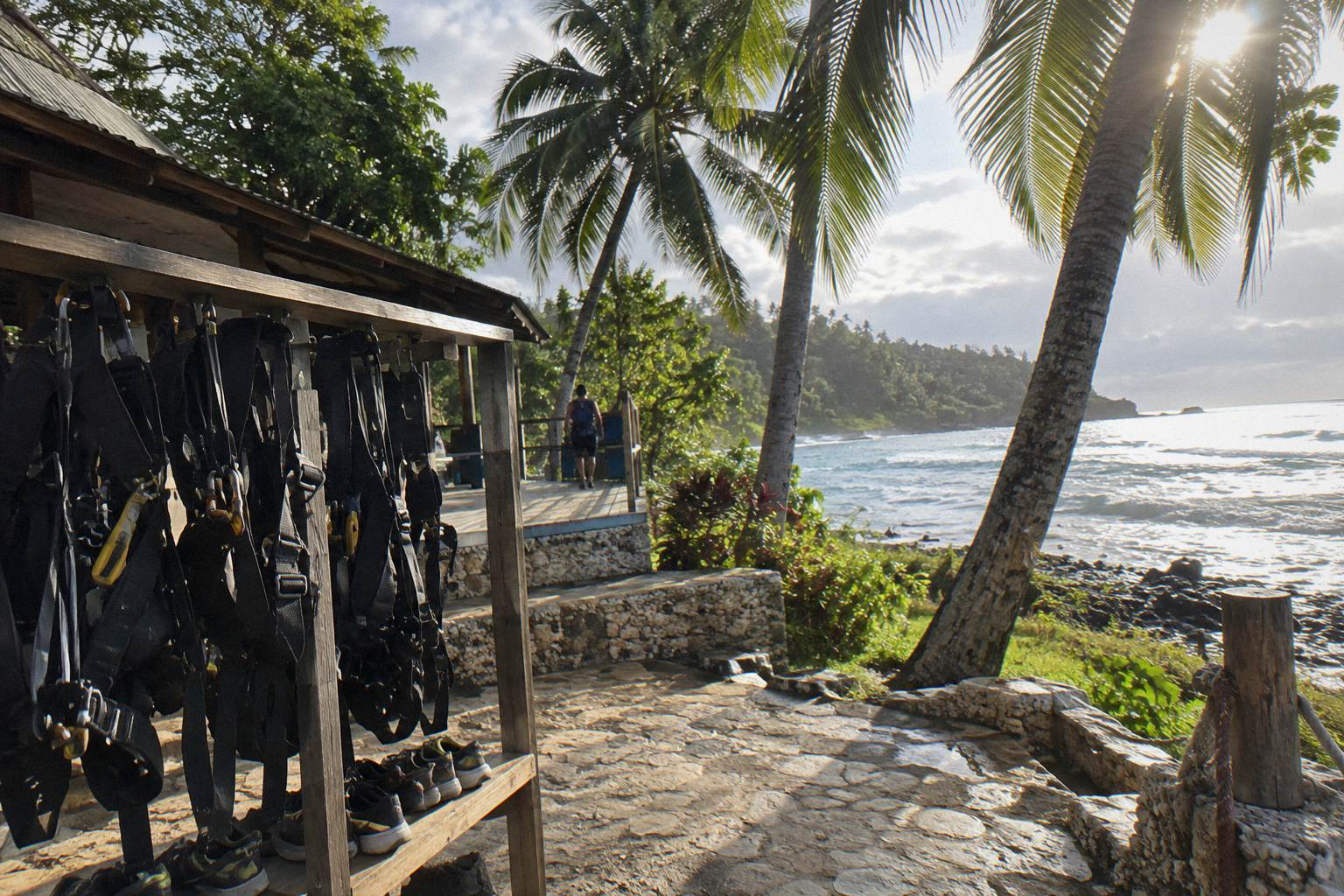
Wear shorts, a T-shirt and closed-toe sports shoes, with nothing loose that can interfere with a harness. At the Momi Bay course cameras need a strap or helmet strap, and water bottles, backpacks and belt packs stay off the course. At the Sleeping Giant park bring waterproof shoes, a towel, sunscreen, bug repellent and a camera or glasses strap.
In short: dress in comfortable clothing that does not interfere with the harness, meaning shorts, a T-shirt and closed-toe sports shoes, and leave anything loose behind. The two courses publish slightly different rules. At Momi Bay, cameras ride only on a strap or helmet strap, and no water bottles, backpacks or belt packs go on the course. At Sleeping Giant in Sabeto, the park asks for waterproof shoes, a towel, sunscreen and bug repellent, plus a camera and glasses strap.
You have booked, the transfer is sorted, and the question left is the practical one: what actually goes on your body and in your day bag. The answer starts with the course you chose, because the two zipline parks near Nadi sit in different terrain and publish their own rules. You can compare the rides themselves in the Momi Bay and Sleeping Giant comparison guide, but for packing purposes the short version is this: the 16-line course at Momi Bay with cave exploration is a forest and limestone-cave day about 3 hours long, while the 7-line Sleeping Giant park at Sabeto adds two waterfalls and a jungle safari walk, about 6 hours door to door. Water proximity changes the kit list.
| Fact | Detail |
|---|---|
| Core clothing rule (Momi Bay) | Comfortable clothing that does not interfere with the harness; shorts, T-shirt and running shoes typical |
| Clothing to avoid (Momi Bay) | Skirts, dresses and bathing suits |
| Footwear (Momi Bay) | Closed-toe sport shoes best, strap-on sandals acceptable, no bare feet |
| Camera rule (Momi Bay) | Cameras only with a strap; a GoPro on a helmet strap |
| Banned on course (Momi Bay) | Water bottles, backpacks, belt packs |
| Kit list (Sleeping Giant) | Waterproof shoes, towel, sunscreen, bug repellent, camera and glasses strap |
| Weather rule (Momi Bay) | Runs in all weather except lightning overhead, high winds and especially heavy rain |
| Fitness link | Momi Bay: 15 minute uphill walk; Sleeping Giant: 10 to 15 minutes uphill, about 20 trail stairs |
What Should You Wear Ziplining In Fiji?
For ziplining in Fiji, wear shorts, a T-shirt and running shoes, the outfit Zip Fiji at Momi Bay describes as typical for its 16-line course. Anything long, flowy or restrictive, including skirts, dresses and bathing suits, is not appropriate because the harness wraps your legs and hips, and fabric that bunches under the webbing becomes a problem at the platforms.
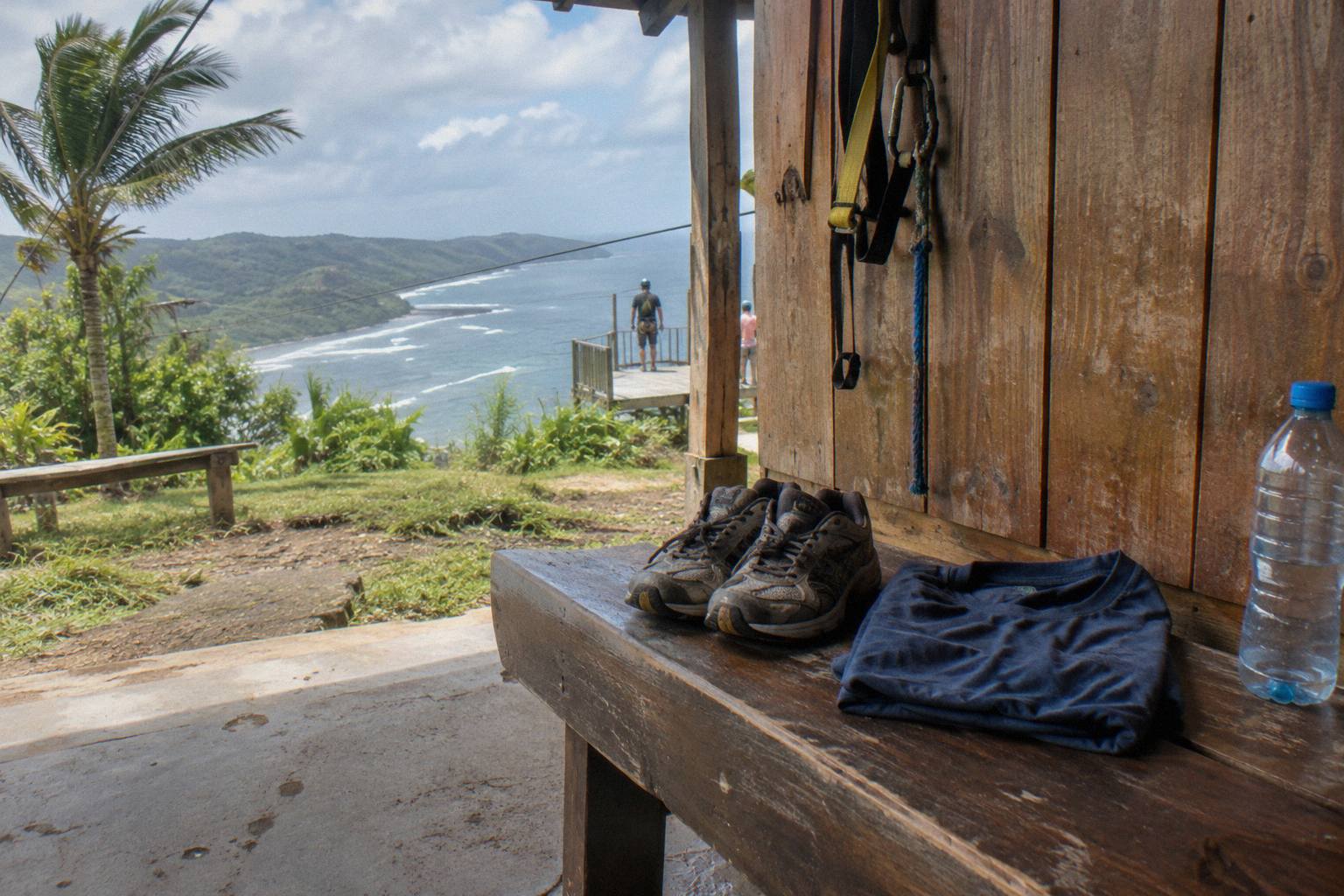
Think about the harness contact points when you choose clothes. The waist belt and leg loops sit against your thighs and hips all day, so seams, bulky pockets and thick waistbands press in under load. Lightweight, close-fitting active wear works; denim works but stiffens when damp. Fiji sits in the tropics, and Nadi's mean daily maximum is 30.2 degrees Celsius across the year, so breathable fabric matters more than warmth. A light rain shell is worth packing in the wet season, more on that below.
Both courses are outdoors for hours at a time, and both involve uphill walking. The Momi Bay course requires a 15 minute uphill walk over uneven ground unassisted, and the Sleeping Giant park asks for 10 to 15 minutes uphill plus about 20 trail stairs. Clothing you can sweat in and scramble in is the whole brief. If you want the fuller picture of what the day actually involves, the step-by-step walkthrough covers the sequence from briefing to last zip.
Sun protection belongs on your body, not just in your bag. Shoulders get the worst of a canopy tour because you stand on open platforms between lines. A T-shirt rather than a singlet, plus sunscreen on the neck and ears, covers most of it. The Sleeping Giant park lists sunscreen explicitly on its bring list, and there is no reason the same logic does not apply at Momi Bay.
One thing not to overthink: you do not need specialist gear. Zip Fiji's own operator FAQ, which carries the full clothing and equipment rules, names ordinary everyday kit, and the operator bans guests from bringing their own climbing gear. Harnesses, helmets and lanyards are provided and fitted by the guides at both parks. Your job is simply to wear something the equipment can sit over cleanly.
What Are The Clothing Rules At Each Course?
The two parks publish separate wear lists, and the rules are per course, so treat them independently. At Momi Bay the operator allows comfortable clothing that does not interfere with the harness, with shorts, T-shirt and running shoes as the typical outfit, and skirts, dresses and bathing suits ruled out. At Sleeping Giant the operator points you toward waterproof shoes and swimwear if you are visiting the Orchid Falls section, plus a towel.
The cleanest way to see the split is side by side. The table below keeps each operator's rules on their own side, because a figure stated for one park is never a rule at the other.
| Item | Momi Bay course (Zip Fiji) | Sleeping Giant park (Sabeto) |
|---|---|---|
| Clothing | Comfortable, harness-compatible; shorts and T-shirt typical | Comfortable outdoor wear; swimwear if visiting Orchid Falls |
| Ruled out | Skirts, dresses, bathing suits | None listed |
| Footwear | Closed-toe sport shoes best; strap-on sandals acceptable; no bare feet | Waterproof shoes |
| Camera | Only with a strap; GoPro on a helmet strap | Camera and glasses strap |
| Water contact | Cave chamber on the tour | Two waterfalls on the tour |
| Extra items | Water break included; no bottles carried | Towel, sunscreen, bug repellent |
| Uphill section | 15 minute uphill walk | 10 to 15 minutes uphill, about 20 trail stairs |
The waterfall difference drives most of the kit variation. The Sleeping Giant safari listing, officially the Nadi Zipline, Waterfalls, and Jungle Safari Tour with Lunch, includes two waterfalls and a jungle safari walk, so wet shoes and a towel are realistic needs. The Momi Bay course includes a guided tour of a limestone cave with a skylight, which is a walk-through rather than a swim, so you stay drier there.
Both of those flagship listings carry free cancellation up to 24 hours before the start on the booking page, which matters if you are packing decisions around a booking you have not locked yet. If your day is still open, the half-day planning guide for Nadi runs through how a zipline fits with other commitments.
Price context is worth a line while you decide: amounts on the booking pages are US dollars, from prices per person, and the Momi Bay zipline and cave listing starts at US$100 while the Sleeping Giant safari listing starts at US$88, with both varying by date and group. The abseil combo, which adds three abseils including a 40 metre descent into the Tau Caves on the same Momi course, starts at US$113 and inherits the same clothing logic plus whatever an extra harness on a rope demands, which is again just clean, close-fitting kit.
Where Do You Put Your Phone And Camera?
At Momi Bay the rule is a strap or nothing: cameras ride only with a strap, a GoPro only on a helmet strap, and water bottles, backpacks and belt packs are banned on the course. At Sleeping Giant the park asks you to bring a camera and glasses strap, which points the same direction: anything you carry at height must be attached to you.
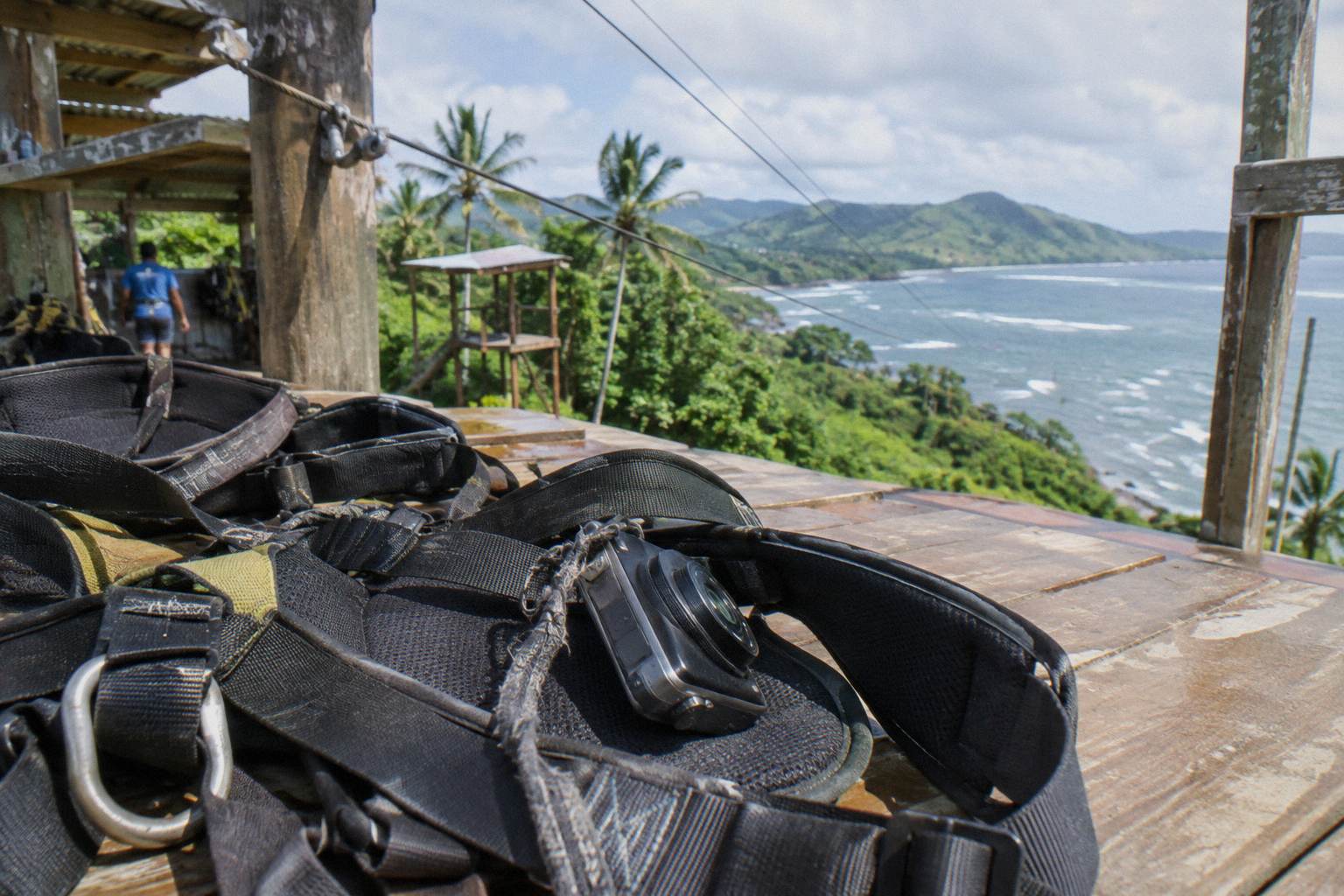
The phone question is the one people ask most, and the answer is the same at both parks in principle. You need your phone attached to your body or left behind, because zipping hands-free at height with a phone in an open pocket is how phones end up in the canopy. A crossbody strap under the harness, a zipped pocket on the leg, or a wrist lanyard all work; the operator's rule at Momi Bay is explicit that loose items and bags stay off the course. Glasses follow the same logic, and Sleeping Giant lists a glasses strap by name.
Where does the rest of your bag go? At Momi Bay, the operator runs a water break into the tour, so you are not carrying fluid, and the free meal and soft drinks come at the end rather than on the course. Your day bag, if you brought one for the shuttle, waits at the Welcome Centre while you ride. The same pattern holds at Sleeping Giant, where the deli lunch with sandwich and soft drink is served at the riverside restaurant, not carried.
| What you carry | Where it goes |
|---|---|
| Drinking water at Momi Bay | Operator water break built into the tour |
| Meal and soft drinks at Momi Bay | Free, served at the end rather than on the course |
| Day bag from the shuttle | Waits at the Welcome Centre while you ride |
| Lunch at Sleeping Giant | Deli sandwich and soft drink at the riverside restaurant |
Lockers and storage are worth one line of homework: ask the operator before the day what storage is available at the base, since the kit lists name the carry rules but not the storage arrangements. That single question settles passports, wallets and change of clothes.
The quick reference below sorts the common carry items into what rides with you and what stays behind, per course. It is worth a screenshot the night before, because the two parks differ on bottles and on water gear.
| Item | Momi Bay course | Sleeping Giant park |
|---|---|---|
| Phone on a strap or lanyard | Rides with you | Rides with you |
| Camera on a strap | Rides with you | Rides with you |
| Water bottle | Stays at the base | Towel and sunscreen instead |
| Backpack or belt pack | Stays at the base | Stays at the base |
| Swimwear | Not needed, cave is a walk-through | Bring for Orchid Falls |
| Own climbing gear | Not allowed | Not applicable |
Whether you ride the standard Momi day or a combo built on the same course, the carry rules do not change, so it is worth checking the live price and dates for your choice before you finalise the bag.
What Footwear Works On A Zipline Course?
Closed-toe sport shoes are the best choice at Momi Bay, where the operator calls them the best option, accepts strap-on sandals, and rules out bare feet outright. At Sleeping Giant the operator asks for waterproof shoes, because the tour touches two waterfalls and a jungle walk. The shared logic is grip and retention, since platforms are timber and the approach is uneven ground.
Old trainers beat new ones here. You will walk uphill over uneven ground for 15 minutes at Momi Bay or 10 to 15 minutes plus about 20 trail stairs at Sleeping Giant, and at the Sabeto park the trail can be muddy near the falls. Shoes you are willing to get dirty, and that dry overnight, are the practical pick. If your day at Sleeping Giant includes the falls, a second pair or a tolerance for damp shoes on the ride home helps.
Thongs, jandals, flip-flops, whatever you call them, fail on every count: no retention, no grip, and at Momi Bay they fall outside the operator's stated rule, which accepts only closed-toe sport shoes or strap-on sandals. Slip-on canvas shoes sit in a grey zone because they retain poorly; a heel strap or lace is what makes a sandal acceptable under the operator's wording.
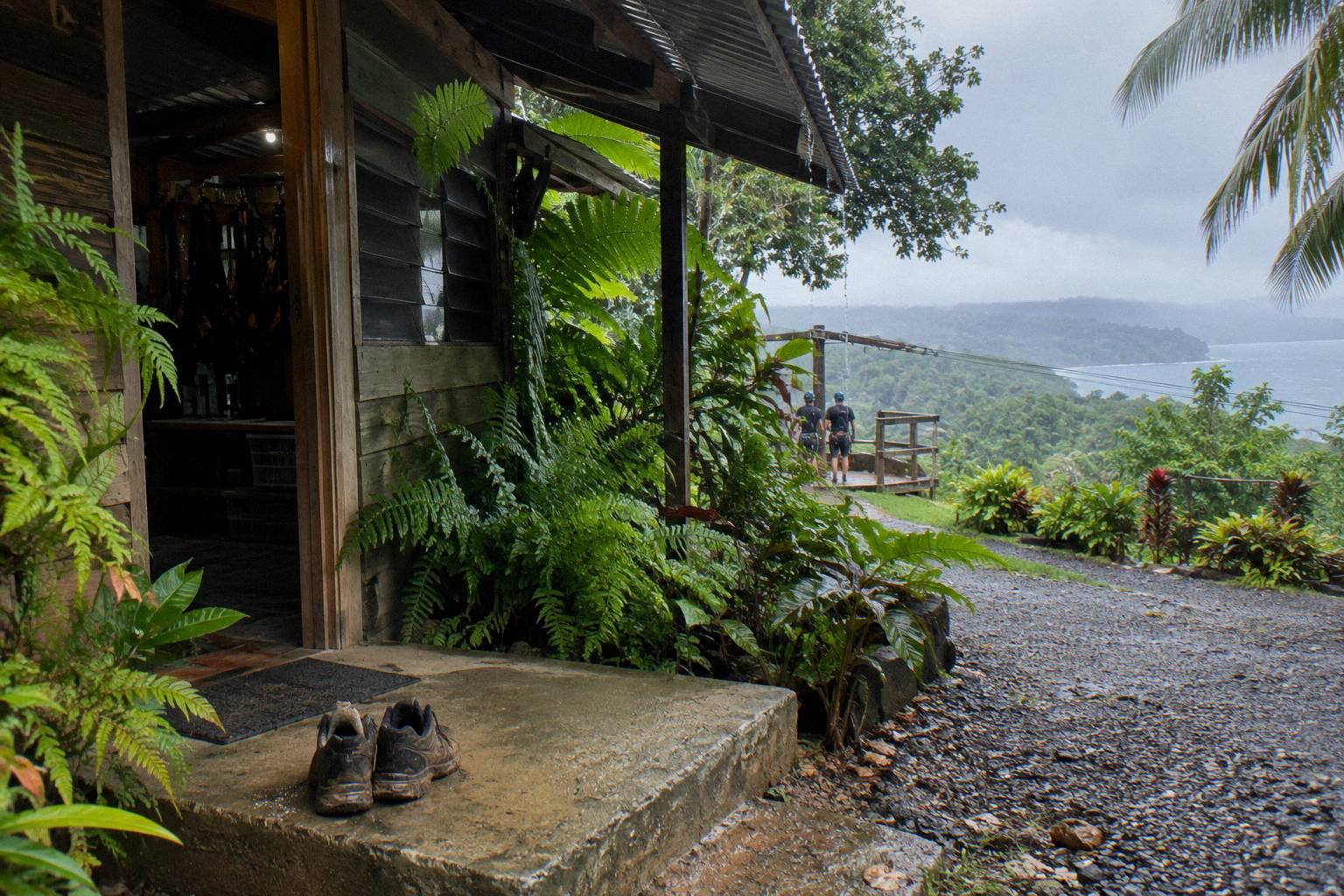
If you are staying on Denarau and making packing decisions from a resort suitcase, the transfer and pickup guide for Denarau runs through the timing, and the footwear logic is the same: pack the trainers in your day bag and change at the hotel, because resort shoes are rarely up to the uphill section at either park.
A quick sort of the common shoe options against the two operators' rules:
| Footwear | Momi Bay course | Sleeping Giant park |
|---|---|---|
| Closed-toe sport shoes | Best option per the operator | Suitable; waterproof preferred |
| Strap-on sandals | Acceptable per the operator | Risky near the waterfalls |
| Thongs or flip-flops | Not acceptable | Not practical on wet trail |
| Bare feet | Ruled out | Ruled out by common sense and terrain |
What Should Stay Behind Or In The Bag?
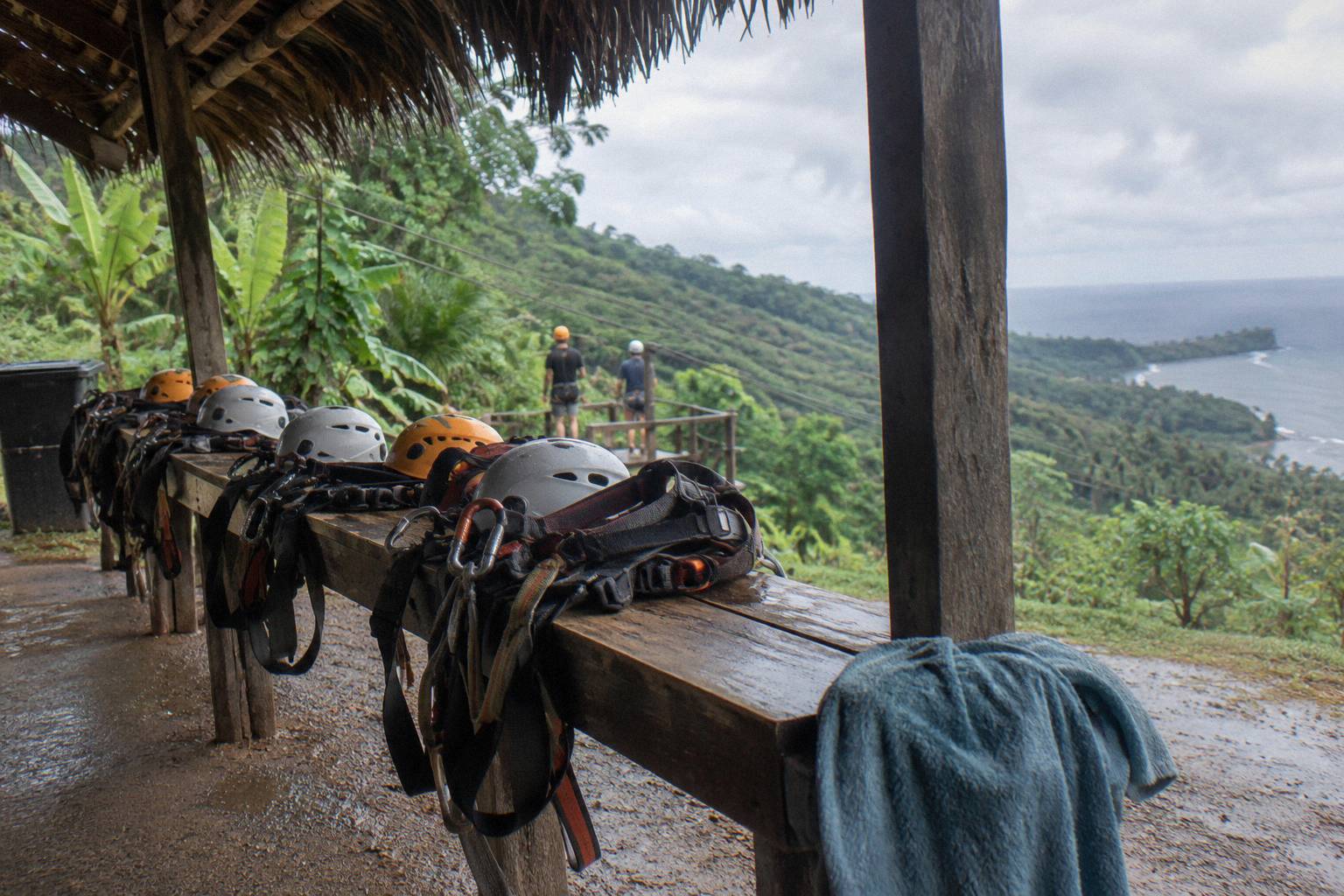
Water bottles, backpacks and belt packs are banned on the Momi Bay course, smoking is not allowed on the tour, and your own climbing gear is not permitted, so leave all of it at the base or the hotel. Loose jewellery, unstrapped glasses and anything in an open pocket belong in the same category at both parks. The Sleeping Giant kit list adds the flip side: towel, sunscreen and bug repellent are the things people forget.
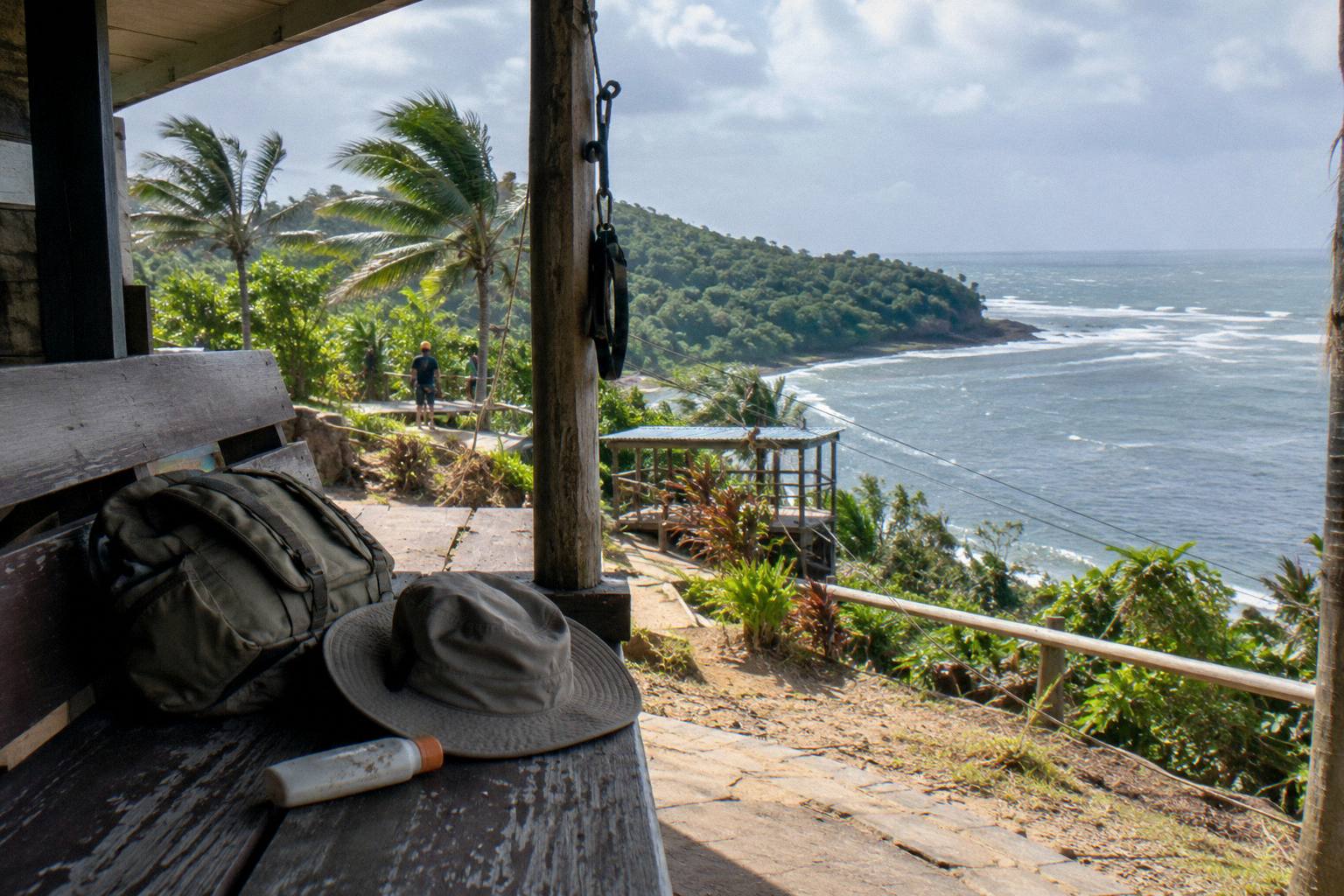
The banned list at Momi Bay is short and specific: no water bottles, no backpacks, no belt packs on the course, cameras only on a strap, a GoPro only on a helmet strap. Intoxicated guests may not take part, which is worth knowing for anyone planning a celebratory morning before an afternoon start at 2:00 pm from the Welcome Centre. None of this is arbitrary; a bottle or bag dropped from a platform is a hazard for everyone below, and the guide team clips and manages the equipment, which is why personal climbing gear stays home too.
The forget list is more common than the banned list. Towel and swimwear matter at Sleeping Giant if Orchid Falls is on your tour. Sunscreen and repellent matter at both, since the jungle sections hold mosquitoes and the platforms hold sun. A hat fits under some helmets and not others, so treat it as optional rather than essential. Cash or a card for extras is sensible at Sleeping Giant, where mud pool food and massage treatments at the hot springs stop cost extra if your booking is the combo that includes it.
If rain is in the air, do not cancel your packing plans, just adjust them. Zip Fiji's stated rule is that the tour runs in all weather except lightning overhead, high winds and especially heavy rain, and Nadi's climate keeps a long wet season with a short dry window in July and August, receiving 365.2 mm of rain in a typical January. A light shell and a dry shirt for after the tour cover it; the rainy season guide goes deeper on what changes.
Does Weather Change The Kit List?
Yes, modestly. Rain does not stop the Momi Bay tour, which the operator says runs in all weather except lightning overhead, high winds and especially heavy rain, so a light rain shell and a dry change for the ride home are the two useful additions. The Sleeping Giant park publishes no weather rule, so you pack for the forecast on the day rather than a stated policy.
The practical wet-day kit is short: a shell that packs small, shoes with grip rather than dryness, a towel, and a plastic bag for the wet pair afterwards. Clothing dries fast in Nadi heat, so one spare set at the hotel solves most of it. Electronics are the real concern, and the strap rules from earlier apply double in rain, since a slick phone drops more easily than a dry one.
| Wet-day kit item | Why |
|---|---|
| Shell that packs small | Rain does not stop the Momi Bay tour |
| Shoes with grip | Grip matters more than dryness |
| Towel | For afterwards |
| Plastic bag | Holds the wet pair of shoes |
| One spare set at the hotel | Clothing dries fast in Nadi heat |
Timing shifts in the wet season too, and the best time of day guide covers how the 9:00 am and 2:00 pm starts at Momi Bay and the 10am or 12pm pickups at Denarau for Sleeping Giant interact with afternoon cloud build-up. The official South Pacific cyclone season runs from 1 November to 30 April, so a quick look at the forecast the night before is just good practice in those months rather than a reason to rebook.
Nadi's rainfall pattern explains why the wet-day additions earn their place. The airport's 1991 to 2020 normals show 365.2 mm in January, 335.5 mm in February and 350.5 mm in March, against 1,999.4 mm across a typical year, so the odds of a shower on any given summer day are simply part of the deal. Nadi still receives much less rain than Suva on the windward side, which is why the west coast around the airport holds the drier reputation. Pack for showers, and you are packed for Fiji.
| Nadi airport, 1991 to 2020 normals | Rainfall |
|---|---|
| January | 365.2 mm |
| February | 335.5 mm |
| March | 350.5 mm |
| Typical full year | 1,999.4 mm |
What Trips People Up On The Day?
The packing mistakes that cost people are wearing skirts or dresses at Momi Bay, arriving in thongs at either park, carrying a phone loose in an open pocket, and bringing a backpack they then have to leave behind at the base. The smaller failures are forgetting sunscreen and repellent at Sleeping Giant and having no towel after the waterfalls. Every one of these is avoidable with a five minute check the night before.
| Your booking | What to pack |
|---|---|
| Sleeping Giant safari | Waterproof shoes, towel, swimwear, sunscreen, repellent, camera strap |
| Standard Momi day | Trainers, shorts and T-shirt, phone on a lanyard, everything else in a bag left at the Welcome Centre |
| Coral Coast pickup version of Momi (from US$115 per person) | Same kit list, plus something for the hour in the van each way |
Run the check against your own booking. Booked the Sleeping Giant safari? Waterproof shoes, towel, swimwear, sunscreen, repellent, camera strap. Booked the standard Momi day? Trainers, shorts and T-shirt, phone on a lanyard, everything else in a bag that stays at the Welcome Centre. Booked the Coral Coast pickup version of the Momi course, which runs from US$115 per person with about an hour in the van each way? Same kit list, plus something for the drive, and the Coral Coast transfer guide lists the hotels the van collects from, including the Shangri-La Yanuca, the Naviti and the Warwick.
The combo bookings add their own wrinkles to the bag. The mud spa combo packs the Zip Fiji course together with a Sabeto Hot Springs and Mud Pool stop of about an hour, so swimwear and a towel earn their place on that day even though the base course alone would not need them. The waterfall safari combo at Sleeping Giant is already covered by that park's water-heavy kit list. The quad bike combo runs light refreshments rather than a full meal and puts you on an all-terrain vehicle for part of the day, so dusty rather than damp is the condition to dress for. The Biausevu waterfall combo adds a 45 minute hike and a kava ceremony to the Momi course, which means real walking shoes become non-negotiable rather than merely recommended.
One mistake is bigger than clothing: assuming the eligibility rules travel between courses. Zip Fiji's FAQ figures, age from 3 and a weight under 135 kilograms with equipment fit confirmed by the Head Guide, are the Momi Bay rules only, and the Sleeping Giant park's own FAQ and booking page carry different thresholds, so confirm age and weight with the park before paying. The weight limit guide unpacks the Momi figures and the general physics of why the limits exist; the age and kids guide does the same for families.
If you are still choosing rather than packing, the two flagship tours below are the ones these rules attach to, and both carry free cancellation up to 24 hours before the start on the booking page. Check availability on the Momi Bay listing if the 16-line, cave and meal format is your pick, or read Ziplines In Fiji for the full course comparison before you commit.
The abseil combo runs on the same course with the same clothing rules, so once the standard kit list is settled you only need to add whatever you want dry for the drive home. See dates and the live price on the booking page before you pack around it.
Common Questions About Packing For A Zipline Day
Can You Wear A Dress Or Skirt Ziplining In Fiji?
No. Zip Fiji, the operator at Momi Bay, names skirts, dresses and bathing suits as not appropriate because the harness needs clean contact with your legs and hips. Shorts and a T-shirt are the typical outfit. The Sleeping Giant park publishes no equivalent ban, but the same harness logic applies.
What Shoes Should You Wear On A Fiji Zipline Tour?
Closed-toe sport shoes are the best choice at Momi Bay, where the operator accepts strap-on sandals but not bare feet. At Sleeping Giant the park asks for waterproof shoes, because the tour passes two waterfalls and a jungle walk. Grip and retention matter more than style at both.
Where Do You Put Your Phone While Ziplining?
On your body, attached. At Momi Bay, cameras ride only on a strap and a GoPro only on a helmet strap, and bags and bottles are banned on the course, so a phone needs a lanyard or a zipped pocket. Sleeping Giant lists a camera and glasses strap on its bring list, pointing the same way.
Can You Bring A Backpack Or Water Bottle On The Course?
Not at Momi Bay. The operator bans water bottles, backpacks and belt packs on the course and builds a water break into the tour instead, with a free meal and soft drinks at the end. Bags wait at the Welcome Centre. Ask the operator about storage at the base before the day.
Do You Need Swimwear For A Fiji Zipline Tour?
Only at Sleeping Giant, and only if your tour visits the Orchid Falls waterfall, where the park's bring list includes swimwear and a towel. The Momi Bay course walks through a limestone cave rather than a swimming hole, so you stay drier there.
Does Rain Change What You Should Wear?
Slightly. The Momi Bay tour runs in all weather except lightning overhead, high winds and especially heavy rain, so a light rain shell and a dry change of clothes for afterwards are the useful additions. The Sleeping Giant park publishes no weather rule, so pack for the forecast on the day.